
The last-ever look inside the Cavendish Laboratory’s 1974 building
Mićo Tatalović
“The first time I encounter the abandoned site of the Cavendish Laboratory at the University of Cambridge, it’s by mistake.
It’s October 2025, and I get off the university bus at the West Hub stop looking for the lab where I’m supposed to start my media fellowship. The fellowship is funded by the European Molecular Biology Organization to allow science journalists to further their scientific education. I’m excited to start my 3-month residency at the lab, learning how we can better report the exciting research in the field of exoplanets and astrobiology, and specifically the search for life on other planets.
But I get a bit turned around and head off in the wrong direction, at least wrong at this point in time. I quickly see a building with the big sign reading ‘Cavendish Laboratory’, but it looks abandoned, with a large skip parked outside. I soon realise this is the old site, moved out of a few weeks earlier, and eventually find the lab’s new building just up the road.
The prestigious Cavendish Laboratory, with its 36 Nobel Prize winners, has an iconic status in the history of science.
The university’s physics department was initially based in central Cambridge where Francis Crick and James Watson famously determined the double- helix structure of the DNA molecule, and where monumental discoveries including the electron and neutron were made, and where new technologies were developed such as the mass spectrograph and X-ray crystallography, which in turn allowed for new discoveries in chemistry and biology.
The lab moved to the outskirts of Cambridge in 1974, 100 years after its foundation, having outgrown its overcrowded site on Free School Lane in central Cambridge. Physics had changed dramatically by the mid-1970s, with the emergence of ‘big science’ such as radio astronomy and particle physics, and there was a need for new large-scale facilities which would enable international collaboration.
The new building in West Cambridge was constructed as a maze of interconnected blocks, with new blocks added when more space was needed. It was home to generations of physicists and many thousands of students over its 50-year lifespan. But ‘Cavendish 2’, as it became known, originally built to last just 25 years, would eventually show its age and could no longer meet the needs of 21st century physics and an ever-expanding department.
The prestigious Cavendish Laboratory, with its 36 Nobel Prize winners, has an iconic status in the history of science.
The university’s physics department was initially based in central Cambridge where Francis Crick and James Watson famously determined the double- helix structure of the DNA molecule, and where monumental discoveries including the electron and neutron were made, and where new technologies were developed such as the mass spectrograph and X-ray crystallography, which in turn allowed for new discoveries in chemistry and biology.
The lab moved to the outskirts of Cambridge in 1974, 100 years after its foundation, having outgrown its overcrowded site on Free School Lane in central Cambridge. Physics had changed dramatically by the mid-1970s, with the emergence of ‘big science’ such as radio astronomy and particle physics, and there was a need for new large-scale facilities which would enable international collaboration.
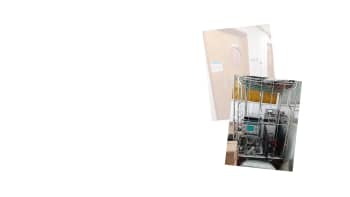
Pictured above: Chemistry Growth lab in the Microelectronics Reseach Centre (MRC) and some of the discarded equipment left behind
Pictured above: Chemistry Growth lab in the Microelectronics Reseach Centre (MRC) and some of the discarded equipment left behind
The new building in West Cambridge was constructed as a maze of interconnected blocks, with new blocks added when more space was needed. It was home to generations of physicists and many thousands of students over its 50-year lifespan. But ‘Cavendish 2’, as it became known, originally built to last just 25 years, would eventually show its age and could no longer meet the needs of 21st century physics and an ever-expanding department.
"The Cavendish Laboratory’s Cambridge West buildings were where careers began, ideas took shape and discoveries were made."
So, in October last year the lab completed its move to the larger, bright and airy custom-built Ray Dolby Centre just up the road on JJ Thomson Avenue. The latest site is much roomier and has space to accommodate more researchers in custom-designed spaces required for modern physics.
Mete Atatüre, Head of the Cavendish Laboratory said: ‘For generations of physicists, the Cavendish Laboratory’s Cambridge West buildings were where careers began, ideas took shape and discoveries were made.
It’s where the spirit of collaboration, curiosity and excellence that has shaped the Cavendish since its birth more than 150 years ago continued to flourish, fostering the journeys of countless students, researchers and staff who worked there.
‘That heritage moved with us to the Ray Dolby Centre, a purpose-built new home for modern research and teaching. As we open this new chapter of our long history, we’re proud to carry the Cavendish legacy forward for the next generations.’
The old building is being razed this summer, once chemical and asbestos decontamination has been completed. The university’s estates division says this ‘will be designed to limit disruption, including noise and vibration, as far as possible’ in the busy area of the Cambridge West Innovation District. After demolition, the site will host a cycle route until new plans are developed for its future.
I was sorry to see the site closed temporarily, but happy to hear it will reopen as a cycling/walking route soon. During my fellowship, I often walked to the new lab via the old building, enjoying its picturesque park with lovely pond and trees in fall colours.
One day, I noticed signs on bike racks warning those still left behind of the imminent closure of the site to the public and the removal of any remaining bikes left there before demolition. I realised this was my last chance to see Cavendish 2 and witness this historic place before it disappears for good.
Luckily, Vanessa Bismuth, the lab’s Head of Communications and Events was kind enough to organise a visit to the site – now under lock and key – at the end of my fellowship, just days before it was shut down for good in February and handed over to third-party contractors.
"The Cavendish Laboratory’s Cambridge West buildings were where careers began, ideas took shape and discoveries were made."
So, in October last year the lab completed its move to the larger, bright and airy custom-built Ray Dolby Centre just up the road on JJ Thomson Avenue. The latest site is much roomier and has space to accommodate more researchers in custom-designed spaces required for modern physics.
Prof Mete Atatüre, Head of the Cavendish Laboratory said: ‘For generations of physicists, the Cavendish Laboratory’s Cambridge West buildings were where careers began, ideas took shape and discoveries were made.
It’s where the spirit of collaboration, curiosity and excellence that has shaped the Cavendish since its birth more than 150 years ago continued to flourish, fostering the journeys of countless students, researchers and staff who worked there.
‘That heritage moved with us to the Ray Dolby Centre, a purpose-built new home for modern research and teaching. As we open this new chapter of our long history, we’re proud to carry the Cavendish legacy forward for the next generations.’
The old building is being razed this summer, once chemical and asbestos decontamination has been completed. The university’s estates division says this ‘will be designed to limit disruption, including noise and vibration, as far as possible’ in the busy area of the Cambridge West Innovation District. After demolition, the site will host a cycle route until new plans are developed for its future.
I was sorry to see the site closed temporarily, but happy to hear it will reopen as a cycling/walking route soon. During my fellowship, I often walked to the new lab via the old building, enjoying its picturesque park with lovely pond and trees in fall colours.
One day, I noticed signs on bike racks warning those still left behind of the imminent closure of the site to the public and the removal of any remaining bikes left there before demolition. I realised this was my last chance to see Cavendish 2 and witness this historic place before it disappears for good.
Luckily, Vanessa Bismuth, the lab’s Head of Communications and Events was kind enough to organise a visit to the site – now under lock and key – at the end of my fellowship, just days before it was shut down for good in February and handed over to third-party contractors.
Vanessa and a colleague were there to guide me through the abandoned site. As we approached, a few bikes were still clinging to the racks alongside a sign warning that they would soon be disposed of if unclaimed. Nearby, grey filing cabinets sat outside waiting to be moved. A giant half-filled skip welcomed us at the main entrance.
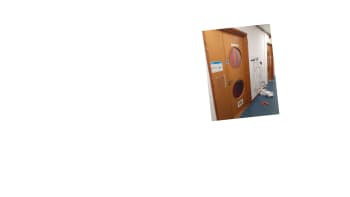
We passed through the empty reception and signed in. An alarm unexpectedly went off. A couple more alarms would sound at random during out visit, while lights flickered or failed to illuminate various dark corridors. Some parts of the buildings were wet, with water dripping from the ceilings, and for safety reasons we were not allowed to visit a couple of areas with leaks. The building was clearly on its last legs. Several walls had been cut open, leaving gaping holes in the sides of old laboratories to allow the removal of specialised equipment like large optical tables that were too big to fit through the door.
Vanessa and a colleague were there to guide me through the abandoned site. As we approached, a few bikes were still clinging to the racks alongside a sign warning that they would soon be disposed of if unclaimed. Nearby, grey filing cabinets sat outside waiting to be moved. A giant half-filled skip welcomed us at the main entrance.
We passed through the empty reception and signed in. An alarm unexpectedly went off. A couple more alarms would sound at random during out visit, while lights flickered or failed to illuminate various dark corridors. Some parts of the buildings were wet, with water dripping from the ceilings, and for safety reasons we were not allowed to visit a couple of areas with leaks. The building was clearly on its last legs. Several walls had been cut open, leaving gaping holes in the sides of old laboratories to allow the removal of specialised equipment like large optical tables that were too big to fit through the door.
The building was clearly on its last legs. Several walls had been cut open, leaving gaping holes in the sides of old laboratories to allow the removal of specialised equipment like large optical tables that were too big to fit through the door.
The silence, the empty library, and a still glowing ‘lecture in progress’ sign in a long-abandoned lecture theatre lent an eerie feeling to the visit. That feeling continued in areas that looked largely untouched by the move: the central café and some offices, still adorned with books, pictures and monitors, white boards filled with equations, and discarded lab coats.
While it sometimes looked like the laboratory had been abandoned in a rush, in reality the move was planned carefully and took 11 months to complete. Around 180 truckloads with a capacity of 18 tonnes were needed to move 107,500 cubic feet of research equipment, crates and furniture belonging to the lab’s 31 research teams.
This included specialised equipment including 47 cryostats, 98 optical tables, and various molecular beam epitaxy and electron beam lithography systems, as well as a cryogenics facility, the teaching laboratories, and the Cavendish Museum collection. Most of the old equipment left by researchers was donated to schools and charities, with remaining materials destined for the skip.
Following the move to the new, upscale, state-of-the-art Ray Dolby Centre, it’s unlikely that the old building will be missed, except perhaps for its use of the picturesque park and pond . A sooty barbecue left in one of the corridors and half-empty liquor bottles on the windowsill perhaps testify to the good times that were had there.
Farewell, Cavendish 2.
Mićo Tatalović is a freelance journalist based in London. He was the first Maria Leptin/EMBO Science Journalism Fellow in residence at the Cavendish Laboratory from October to December 2025.