
MicroBooNE rules out a sterile neutrino but mysteries remain
Magnus Handley
Nature’s most elusive particle, the neutrino, remains mysterious as the MicroBooNE collaboration at Fermilab rules out a fourth flavour as the explanation for several long-standing anomalies.
For particles so small and feebly interacting, neutrinos have caused more than their fair share of headaches for particle physicists over the last century. First predicted by Wolfgang Pauli as an upsetting and ‘desperate remedy’ to conserve energy and momentum in beta decays, their exceptionally low interaction probability and continued identity crises have consistently forced physicists to be creative in the quest to understand their properties.
The modern understanding of neutrino physics came into focus in 1998 when the Super-Kamiokande experiment, and subsequently the Sudbury Neutrino Observatory in 2001, confirmed that the three known types or ‘flavours’ of neutrino – labelled electron, muon and tau – could change over time. For instance, by the time electron neutrinos created in the centre of the Sun arrive at Earth, a significant fraction will have transformed into either muon or tau neutrinos. Known as neutrino oscillation, this phenomenon solved two outstanding mysteries — the so-called ‘solar’ and ‘atmospheric’ neutrino problems — both stemming from the fact that fewer neutrinos of a certain type reached our detectors than expected. This also gave another critical piece of information, that neutrinos had mass, an unexpected property not previously predicted by the Standard Model.
"[Neutrinos's] exceptionally low interaction probability and continued identity crises have consistently forced physicists to be creative in the quest to understand their properties"
To properly investigate the anomalies, a different detector technology was required.
At first glance, the picture seemed almost complete. Nature appeared to contain three neutrino flavours, each interacting only through the weak nuclear force and each capable of oscillating into the others over long distances because of their tiny, but non-zero, masses.
Sadly, the picture failed to stay so simple.
Several short-baseline experiments from the late 1990s onwards, most notably the LSND experiment at Los Alamos and MiniBooNE at Fermilab, reported unexplained excesses of electron-neutrino-like events at low energies. Taken together, these amounted to a six-sigma discrepancy with prediction – meaning there is around a one in 500 million chance of the results being a statistical fluke. The neutrino beams studied by these experiments start as primarily muon neutrinos, and while we know that high-energy neutrinos can change type over long distances, the detectors here were far too close to their respective sources for that transformation to occur with only the three known flavours.
At first glance, the picture seemed almost complete. Nature appeared to contain three neutrino flavours, each interacting only through the weak nuclear force and each capable of oscillating into the others over long distances because of their tiny, but non-zero, masses.
Sadly, the picture failed to stay so simple.
Several short-baseline experiments from the late 1990s onwards, most notably the LSND experiment at Los Alamos and MiniBooNE at Fermilab, reported unexplained excesses of electron-neutrino-like events at low energies. Taken together, these amounted to a six-sigma discrepancy with prediction – meaning there is around a one in 500 million chance of the results being a statistical fluke. The neutrino beams studied by these experiments start as primarily muon neutrinos, and while we know that high-energy neutrinos can change type over long distances, the detectors here were far too close to their respective sources for that transformation to occur with only the three known flavours.
To properly investigate the anomalies, a different detector technology was required.
So, what was going on?
A popular hypothesis invoked the addition of a fourth non-interacting, or ‘sterile’ neutrino: providing an extra pathway for the shapeshifting between muon and electron-type neutrino flavours. While very successful detectors in many ways, the data from LSND and MiniBooNE couldn’t tell us whether there really was a new particle, or if something else was happening which mimicked the oscillation signature. The reason was the technology used, as both LSND and MiniBooNE relied on Cherenkov light cones as their primary way of identifying particles. These cones of light are produced when a charged particle travels faster than light would through the mineral oil in the detector: a process somewhat analogous to a sonic boom. The problem with this is that it’s very difficult to distinguish between the particle showers produced by an electron (such as those produced when electron neutrinos interact) and those from photons. To properly investigate the anomalies, a different detector technology was required.
MicroBooNE, a follow-on detector built to resolve these anomalies, is a Liquid Argon Time Projection Chamber (LArTPC) filled with 170 tonnes of the liquefied noble gas. When a neutrino interacts with an argon nucleus, charged particles are produced which create trails of ionisation. By applying strong electric fields, these trails are pulled to the walls of the detector, where planes of readout wires give high-resolution, almost photographic, representations of the interaction.
A typical event display from the MicroBooNE detector, showing a high-resolution readout of a neutrino interaction creating several daughter particles.
When trying to resolve electron-like showers, this has two main advantages over Cherenkov detectors. Firstly, LArTPCs are excellent calorimeters, and when photons pair-produce to create an electron-positron pair, they deposit roughly twice as much energy per unit length as when an electron creates a shower in the detector. In addition to this, photon showers are often easy to identify because they often travel a considerable distance away from the interaction point before pair production, giving a characteristic gap between the shower and interaction vertex.
So, what was going on?
A popular hypothesis invoked the addition of a fourth non-interacting, or ‘sterile’ neutrino: providing an extra pathway for the shapeshifting between muon and electron-type neutrino flavours. While very successful detectors in many ways, the data from LSND and MiniBooNE couldn’t tell us whether there really was a new particle, or if something else was happening which mimicked the oscillation signature. The reason was the technology used, as both LSND and MiniBooNE relied on Cherenkov light cones as their primary way of identifying particles. These cones of light are produced when a charged particle travels faster than light would through the mineral oil in the detector: a process somewhat analogous to a sonic boom. The problem with this is that it’s very difficult to distinguish between the particle showers produced by an electron (such as those produced when electron neutrinos interact) and those from photons. To properly investigate the anomalies, a different detector technology was required.
MicroBooNE, a follow-on detector built to resolve these anomalies, is a Liquid Argon Time Projection Chamber (LArTPC) filled with 170 tonnes of the liquefied noble gas. When a neutrino interacts with an argon nucleus, charged particles are produced which create trails of ionisation. By applying strong electric fields, these trails are pulled to the walls of the detector, where planes of readout wires give high-resolution, almost photographic, representations of the interaction.
A typical event display from the MicroBooNE detector, showing a high-resolution readout of a neutrino interaction creating several daughter particles.
A typical event display from the MicroBooNE detector, showing a high-resolution readout of a neutrino interaction creating several daughter particles.
When trying to resolve electron-like showers, this has two main advantages over Cherenkov detectors. Firstly, LArTPCs are excellent calorimeters, and when photons pair-produce to create an electron-positron pair, they deposit roughly twice as much energy per unit length as when an electron creates a shower in the detector. In addition to this, photon showers are often easy to identify because they often travel a considerable distance away from the interaction point before pair production, giving a characteristic gap between the shower and interaction vertex.
The high-resolution nature of the detector readout requires more complicated processing, or ‘reconstruction’, to steadily build up from raw charge readout ‘hits’, to clusters of hits in two dimensions and eventually to three-dimensional objects which correspond as well as possible to real particles. The development of a reconstruction package known as Pandora has been one of the major contributions of Cambridge researchers to the MicroBooNE experiment, with extensive use across many different analyses and dataset validation efforts, as well as on other LArTPC experiments.
To best investigate the MiniBooNE excess, MicroBooNE was built in the same Booster Neutrino Beamline (BNB), at a very similar distance from the neutrino source. Even with this, neutrino oscillation physics is fickle, and if we were unlucky then there are portions of parameter space where the effect of oscillation into electron neutrinos would be cancelled out by the disappearance of the (small, but non-zero) intrinsic electron-neutrino content of the beam.
Enter MicroBooNE’s secret weapon: a second neutrino beam!
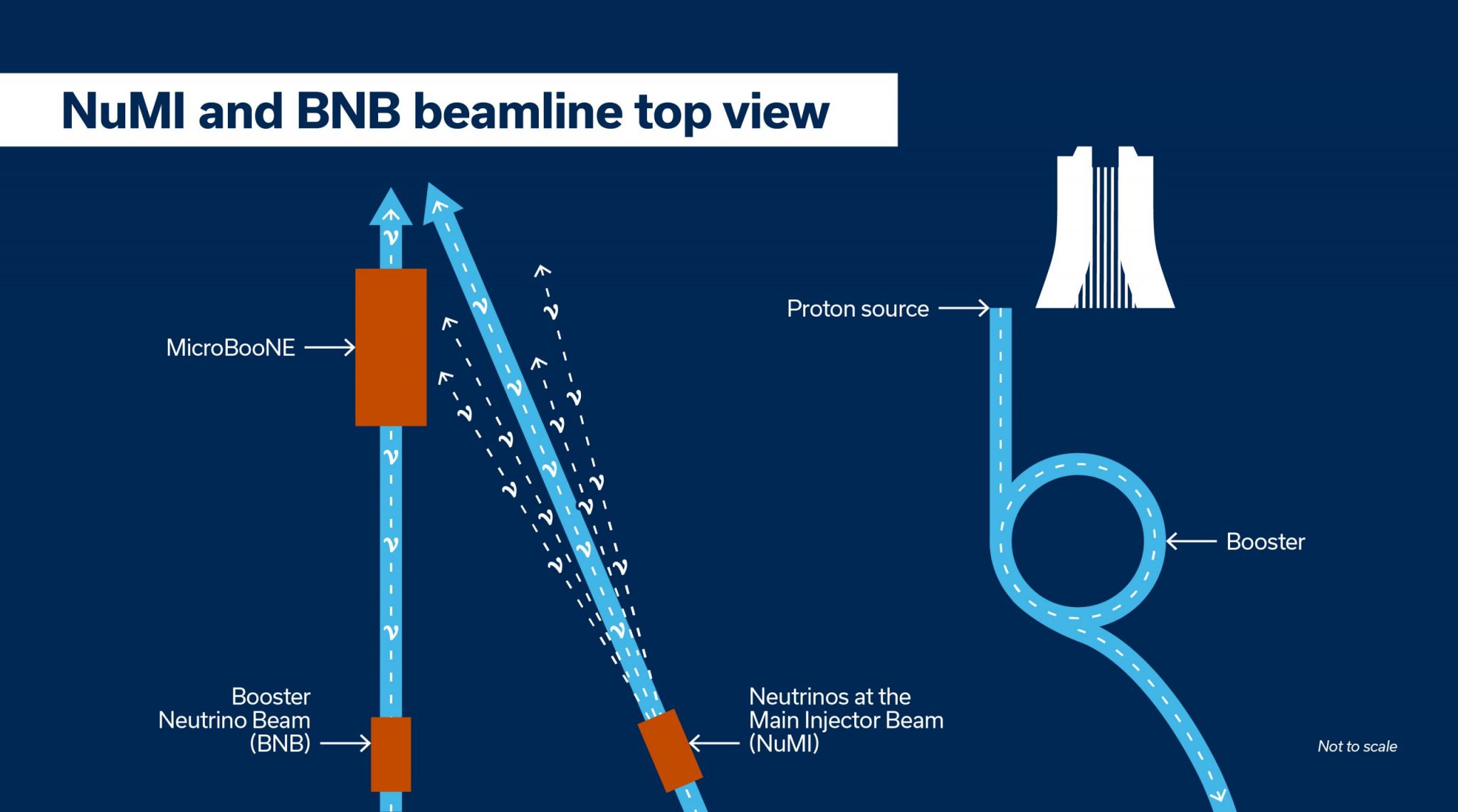
A quirk of positioning means that MicroBooNE also sees neutrinos from the main injector neutrino beamline (NuMI), but significantly off-axis, at an angle of eight degrees from the target. This means the intrinsic electron neutrino content of NuMI is much higher than that of the BNB, breaking the potential degeneracy and allowing us to probe oscillations which might otherwise have required multiple detectors to see.
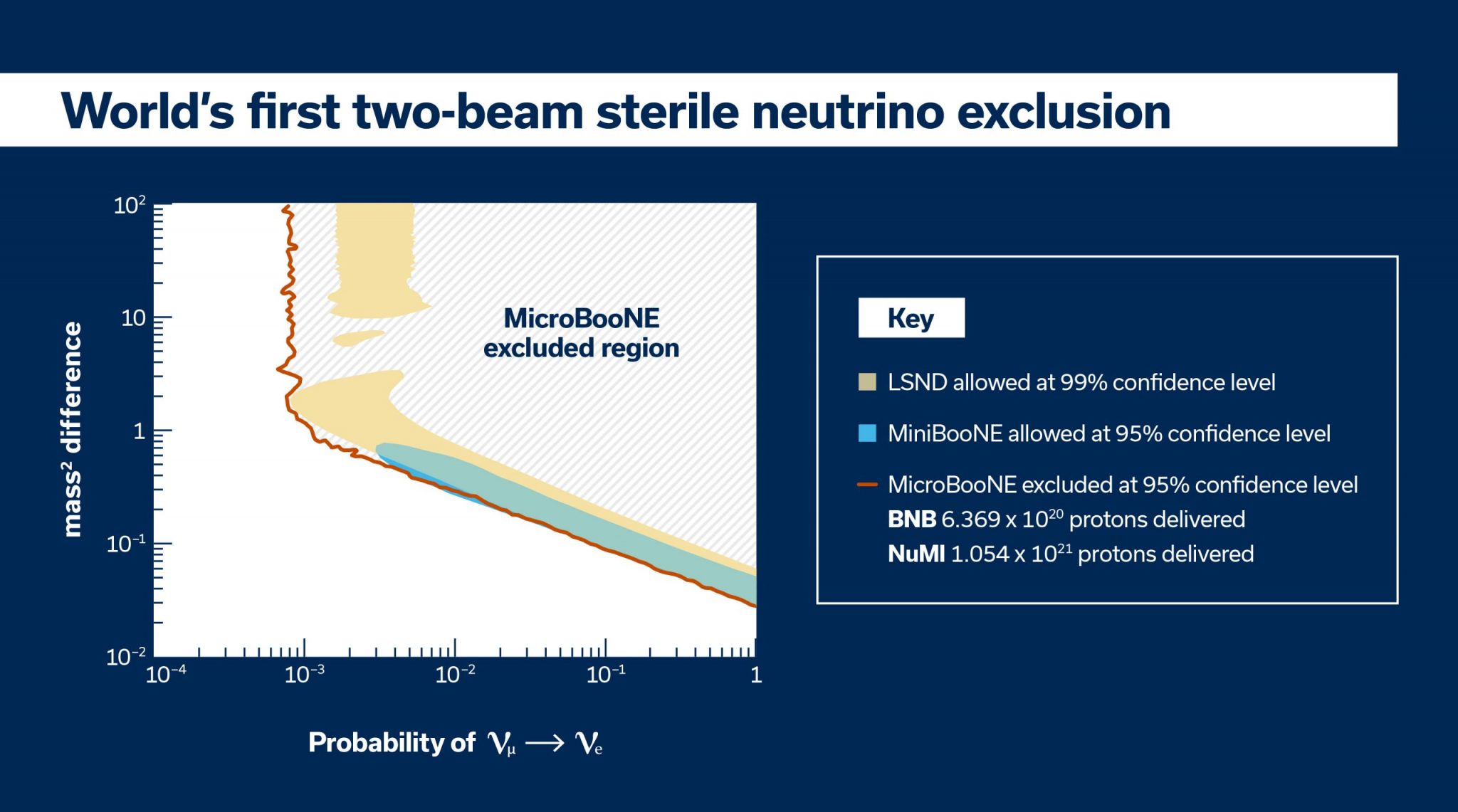
When the data from both beams was analysed, no significant excess of electron-neutrino-like events was seen. In fact, MicroBooNE didn’t observe anything resembling the excesses seen by MiniBooNE. The resultsiThe MicroBooNE Collaboration. Search for light sterile neutrinos with two neutrino beams at MicroBooNE. Nature 648, 64–69 (2025) almost entirely exclude the region of phase space where a single light sterile neutrino would have needed to sit to explain MiniBooNE — effectively shutting this down as a viable hypothesis.
Taken together, what does this all mean?
The new MicroBooNE results end a chapter in the hunt to understand these anomalies by ruling out a high-profile hypothesis, but fail to complete the story. LSND and MiniBooNE still saw more events than expected, and the community is yet to understand why. Was a Standard Model background underpredicted? Was something mismodeled that is better accounted for in modern simulation? Or is there still some new physics out there, potentially invoking a more complex phenomenological picture?
Attempts to resolve this are far from over, with continued efforts from many different experiments globally. The MicroBooNE collaboration continues to investigate its dataset, looking for hints of more complex beyond-the-standard model scenarios.
Separately, other collaborations like the short-baseline neutrino (SBN) program (a collection of multiple detectors now in the Fermilab beams) will push the bounds significantly further and pave the way for next-generation experiments like DUNE: a mega-experiment currently under construction and for which Cambridge researchers continue to lead development.
Looking forward, MiniBooNE sits as a small part of a bigger puzzle, which is still some way off from being completed. Several open questions remain. Why do neutrinos have mass at all? What is the order of those masses? Do neutrinos and antineutrinos oscillate differently? This last question could help to understand the matter-antimatter asymmetry of the early universe. So as several neutrino megaprojects across the world – DUNE in the US, Hyper-Kamiokande in Japan, and JUNO in China – start to switch on over the next few years, we might soon get to know nature’s shiest particle a little better.
Reference: The MicroBooNE Collaboration, ‘Search for light sterile neutrinos with two neutrino beams at MicroBooNE’. Nature (2025). DOI: 10.1038/s41586-025-09757-7
Magnus Handley is a PhD student in the High Energy Physics Group, working on the DUNE and MicroBooNE experiments.