
Twists in the flow
Cambridge-led physicists show that voltage-driven torque spins DNA into supercoils (plectonemes), not just knots – reshaping how we interpret “tangled” nanopore signals.
Fei Zheng
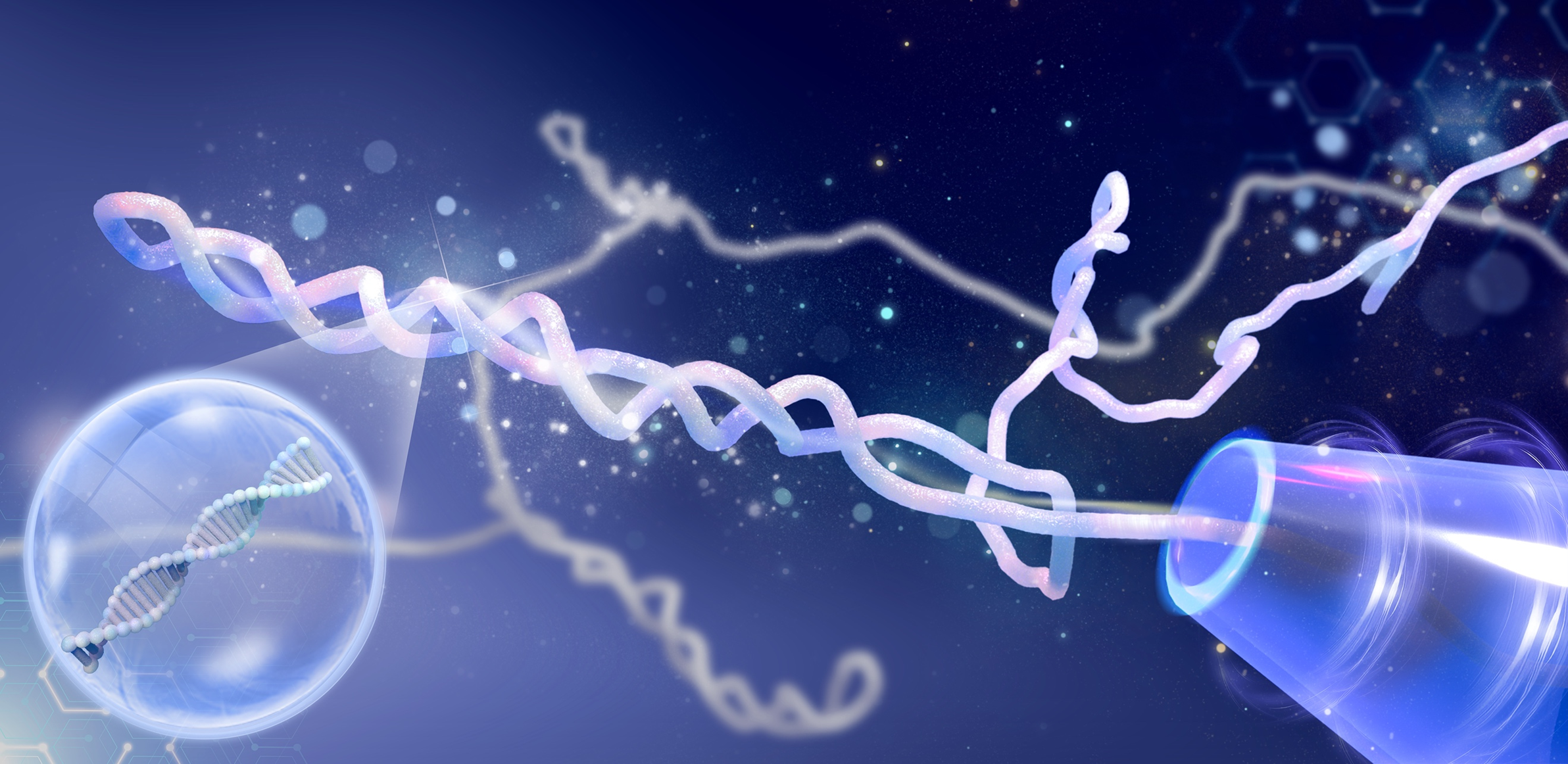

For years, unusually deep, multi-level blockades in solid-state nanopores were widely interpreted as knots: transient entanglements slipping through under tension as DNA is pulled by an electric field. A Cambridge-led team has now shown that many of these events are not knots at all, but plectonemes – twisted supercoils that arise because the nanopore makes DNA rotate. Recognising this “second axis” of motion, torsion, reframes how we interpret complex nanopore signals and opens routes to sense DNA integrity.
The core observation is simple. Double-stranded DNA is a right‑handed helix. Inside a biased nanopore, electro‑osmotic flow grazes the helix and exerts a tangential drag – a torque – that
spins the in‑pore segment. Because translocation is fast and far from equilibrium, that twist does not relax in place; it propagates along the cis side and winds the external strand into plectonemic loops. When a loop reaches the pore, multiple strands pass together, deepening the current blockade and mimicking the amplitude of a knot – but with a very different timescale.


Possible DNA structures inside the nanopore. Credit: Fei Zheng.
Possible DNA structures inside the nanopore. Credit: Fei Zheng.
Two signatures make the case. First, the fraction of “≥3‑strand” events rises steeply with voltage and polymer length in both glass and Si3N4 nanopores, far exceeding the maximum knotting probability predicted by equilibrium polymer statistics. Increasing voltage cannot create new knots, yet it consistently produces more deep blockades – pointing to a torque‑driven origin. Second, time traces separate the culprits: knot signals are brief spikes, typically lasting only tens to hundreds of microseconds as tension tightens and pulls them through; plectonemes linger as millisecond‑long plateaus at the same blockade level, reflecting extended supercoils sustained by ongoing twist.
To decouple force and torque, the team turned to coarse‑grained molecular dynamics, modelling DNA as a twistable elastic chain. Applying controlled pulling forces and torques to an 8 kilobase pair (kbp) strand reproduced the experiments: above a torque threshold that
increases with pulling force, plectonemes nucleate and survive to the pore, and the simulated ionic current shows the same long level‑3 plateaus. When starting from unknotted, torsionally relaxed configurations, every ≥3‑strand event was a plectoneme; knots appeared only if present initially, and their signals were short.
A critical control is to block twist propagation. The researchers engineered three 7.2 kbp constructs with identical sequences but different torsional continuity: intact dsDNA; a “nicked” version with regularly spaced phosphodiester breaks; and a “1‑nt gap” variant with an extra missing base at each nick. Across 400–800 mV, the probability of tangled events followed Pintact > Pnicked > P1‑nt gap at every bias and increased with voltage – exactly what one expects if extended twist is required to build and maintain plectonemes, and inconsistent with equilibrium knotting, which is insensitive to local nicks.

Torsion-driven plectoneme formation. Credit: Fei Zheng.
Torsion-driven plectoneme formation. Credit: Fei Zheng.
Why it matters goes beyond tidying up signal assignments. Distinguishing plectonemes from
knots by duration and voltage scaling improves structural calling in nanopore sensing, reducing false positives in studies that rely on deep blockade levels. Because nicking disrupts torsion and suppresses plectonemes, their statistics offer a potential proxy for backbone integrity, hinting at label‑free assays for DNA damage. More broadly, voltage‑driven nanopores emerge as dual‑role platforms that both generate torsion and sense the resulting supercoils, enabling controlled studies of supercoiling dynamics and topoisomerase action at the single‑molecule level. In this picture, nanopore translocation is not just one‑dimensional pulling; it is the coupled propagation of tension and torsion along a helical polymer – turning “ambiguous tangles” into a predictable, tuneable class of signals.
Reference:
F. Zheng et al., 'Torsion-Driven Plectoneme Formation During Nanopore Translocation of DNA Polymers', Physical Review X (2025).