
The Goldilocks zone of bouncing droplets
Jamie Mclauchlan and Anton Souslov
Scientists have discovered that microscopic water droplets rebound off surfaces only in a narrow “just-right” speed range, a finding with real-world implications from inkjet printers and crop sprays to the behaviour of virus-carrying aerosols.


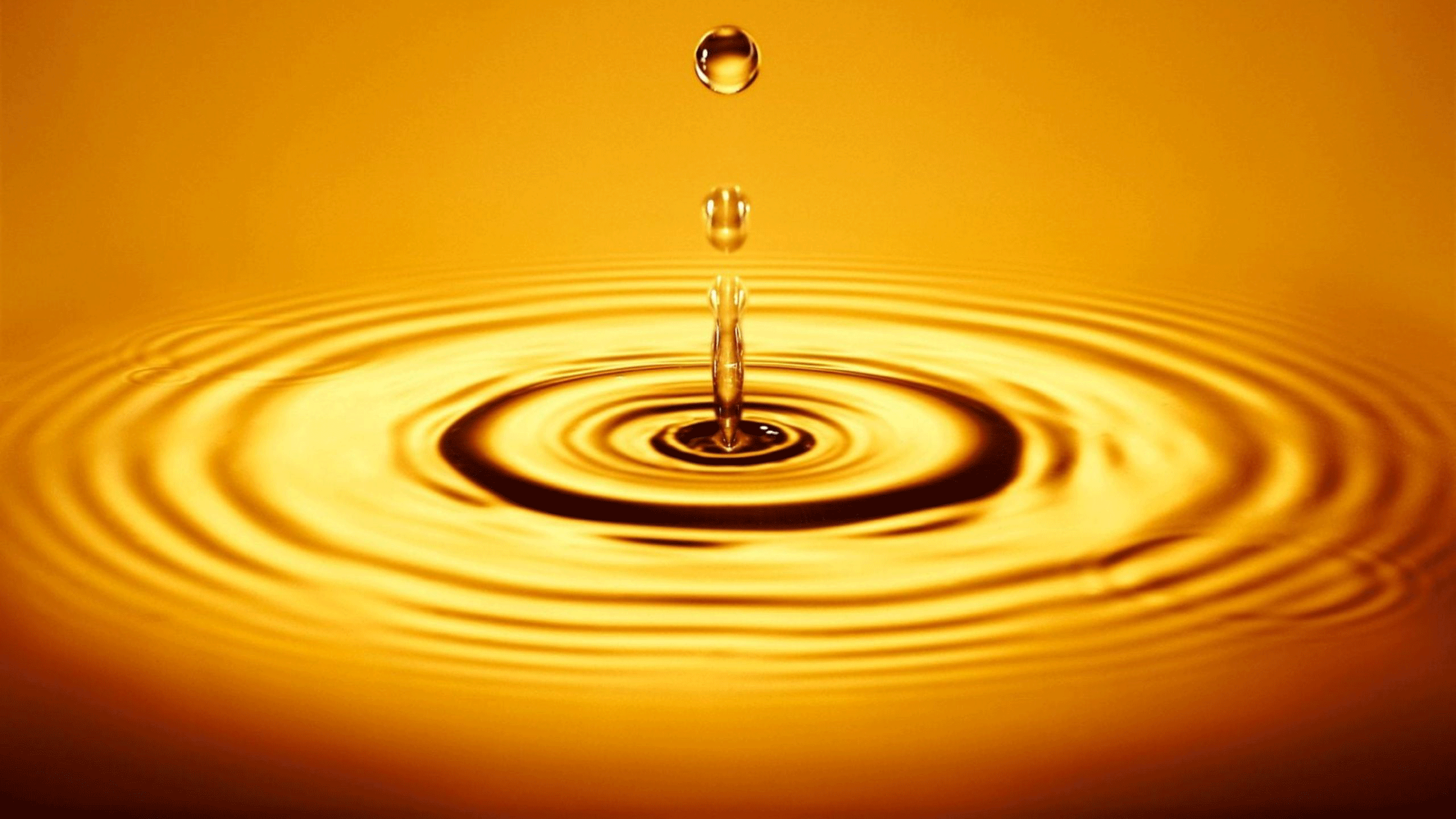
We encounter droplet impacts in our everyday lives, from raindrops splashing on tree leaves to inkjet printers depositing droplets on A4 paper.
Understanding how droplets spread, bounce and splash is not only intuitively relatable but also crucial in everything from how rain interacts with buildings and crops to how we design better waterproof coatings, cooling sprays and water-repellent materials.
For everyday, millimetre-sized droplets, the fluid mechanics governing such intuitive behaviour as spreading, bouncing and splashing has been extensively explored. On highly water-repellent surfaces, such droplets rebound across a broad range of conditions that include different droplet sizes and liquid properties, and this behaviour generally does not depend strongly on the velocity. However, droplets that are too heavy or too viscous stop bouncing. On flat surfaces droplets can bounce off a trapped air film, and on all surfaces increasing impact speed eventually prompts splashing.
'At micrometre scales, new fundamental phenomena emerge. Splashing is suppressed as interfacial effects become dominant.'
These are the surface-level forces that control how liquids meet the surrounding air or a solid surface. Any air films become unstable and gravity is negligible. In this regime, a droplet can either stick or bounce. Despite the relevance of microscopic droplets to aerosol transport, disease transmission, printing and surface engineering, the conditions that govern bouncing at this scale have remained unclear.


To investigate this, we worked together with colleagues at the Universities of Amsterdam, Durham, Bristol, and Bath. We generated water droplets with diameters between approximately 30 and 50 micrometres and directed them towards hydrophobic Teflon and nanoparticle coated glass surfaces at velocities between 1 and 10 metres per second. These impacts unfold on microsecond timescales and were recorded using high-speed imaging at 100,000 frames per second. The resulting images capture fine details of microdroplet deformation and rebound that have not previously been resolved at this scale.


Droplets impacting a nanoparticle coated glass surface, increasing in speed from top row to bottom. From 2m/s to 7m/s, each image taken 0.01ms apart.
Droplets impacting a nanoparticle coated glass surface, increasing in speed from top row to bottom. From 2m/s to 7m/s, each image taken 0.01ms apart.


Two microdroplets landing on the same water-repellent surface. At a low Weber number (left), the droplet lacks inertia to bounce off so sticks to the surface and oscillates. At a higher Weber number (right), the droplet bounces back, splits into two, and leaves a small satellite droplet on the surface.
Left video
Water droplet impacting and sticking to nanoparticle-coated substrate.
We = 2.5
Oh = 0.017
Recorded at 100,000 FPS
Played at 6 FPS
Right video
Water droplet impacting and bouncing off nanoparticle-coated substrate.
We = 10
Oh = 0.017
Recorded at 100,000 FPS
Played at 6 FPS


Time-sequence images showing low-velocity sticking, intermediate-velocity rebound, and high-velocity dissipative sticking as droplets impact the surface.
Time-sequence images showing low-velocity sticking, intermediate-velocity rebound, and high-velocity dissipative sticking as droplets impact the surface.
We chart these outcomes in a dimensionless phase space spanned by the Weber number, which compares inertia (a droplet’s resistance to changing its motion) to surface tension, and the Ohnesorge number, which captures the influence of viscosity (how thick the liquid is) relative to inertia and capillarity (the surface-tension effect that makes droplets pull themselves into a sphere). Together, these two numbers show whether a droplet’s motion is dominated by momentum, viscosity or surface tension. We find dependence on both. This representation allows us to translate dimensionless limits into experimentally relevant physical criteria. For instance, the Ohnesorge threshold can correspond to a size cut-off: on surfaces such as Teflon, water droplets smaller than about 20 micrometres never rebound, regardless of impact speed. In this regime, viscous forces dominate, and because there is no inertia after retraction, bouncing is no longer possible.
We chart these outcomes in a dimensionless phase space spanned by the Weber number, which compares inertia (a droplet’s resistance to changing its motion) to surface tension, and the Ohnesorge number, which captures the influence of viscosity (how thick the liquid is) relative to inertia and capillarity (the surface-tension effect that makes droplets pull themselves into a sphere). Together, these two numbers show whether a droplet’s motion is dominated by momentum, viscosity or surface tension. We find dependence on both. This representation allows us to translate dimensionless limits into experimentally relevant physical criteria. For instance, the Ohnesorge threshold can correspond to a size cut-off: on surfaces such as Teflon, water droplets smaller than about 20 micrometres never rebound, regardless of impact speed. In this regime, viscous forces dominate, and because there is no inertia after retraction, bouncing is no longer possible.
Time-sequence images showing low-velocity sticking, intermediate-velocity rebound, and high-velocity dissipative sticking as droplets impact the surface.
Time-sequence images showing low-velocity sticking, intermediate-velocity rebound, and high-velocity dissipative sticking as droplets impact the surface.


'On surfaces such as Teflon, water droplets smaller than about 20 micrometres never rebound, regardless of impact speed.'
To rationalise this behaviour, we constructed a minimal mechanical model in which the droplet behaves as a mass-spring-damper-mass-spring system subject to a weak adhesive force of the second spring, where a large extension means a bounce. Despite its simplicity, the model reproduces the observed rebound boundary and highlights the central balance between inertia, surface tension, viscous dissipation, and adhesion. A non-wetting surface is one that water cannot easily adhere to. Instead of spreading out, a droplet sits on top of it like a tiny bead, much as rain rolls off a lotus leaf or a freshly waxed car. In our model, we represent this by letting the second spring constant become extremely small, meaning the droplet feels almost no adhesive pull from the surface. As a result, the range of conditions in which the droplet can bounce becomes much wider and no longer depends on how fast it hits.


A velocity-droplet diameter graph showing bouncing and sticking with water on Teflon
A velocity-droplet diameter graph showing bouncing and sticking with water on Teflon
'rebounding droplets are less likely to freeze onto aircraft wings or power lines'
This transition between microdroplets depositing or rebounding off a surface has practical consequences. In indoor environments, droplets that stick to surfaces are removed from the air, whereas droplets that rebound can remain airborne. In agriculture and printing, reliable deposition depends on controlling this boundary.
The same principle also plays a role in anti-icing, where rebounding droplets are less likely to freeze onto aircraft wings or power lines, and in spray cooling, where good contact between droplets and hot surfaces improves heat removal. It even influences the performance of everyday products, such as how effectively cleaning sprays or disinfectants wet a surface rather than bouncing off. Engineering surface properties to shift the rebound threshold, therefore, offers a route to influencing droplet behaviour in real systems.
Future work will extend these studies to droplets containing surfactants and polymers.
Surfactants are soap-like molecules that gather at a liquid’s surface and make it easier to stretch, meaning the droplet’s surface tension can change over time. Polymers, in turn, can give the liquid viscoelasticity, allowing it to behave partly like a flowing liquid and partly like a springy solid that stores and releases energy. These behaviours are common in biological systems that introduce additional energy storage and dissipation mechanisms. These effects are expected to change the rebound phase space. The present results provide a foundation for interpreting these more complex cases and for developing predictive control of microscopic droplet impacts.


Future work will extend these studies to droplets containing surfactants and polymers.
Surfactants are soap-like molecules that gather at a liquid’s surface and make it easier to stretch, meaning the droplet’s surface tension can change over time. Polymers, in turn, can give the liquid viscoelasticity, allowing it to behave partly like a flowing liquid and partly like a springy solid that stores and releases energy. These behaviours are common in biological systems that introduce additional energy storage and dissipation mechanisms. These effects are expected to change the rebound phase space. The present results provide a foundation for interpreting these more complex cases and for developing predictive control of microscopic droplet impacts.
Reference:
J. McLauchlan, J.S. Walker, V. Sanjay, M. Jalaal, J.P. Reid, A.M. Squires, & A. Souslov, Bouncing microdroplets on hydrophobic surfaces, Proc. Natl. Acad. Sci. U.S.A. 122 (36) e2507309122, DOI: 10.1073/pnas.2507309122 (2025).