
Nicola Marzari: the 10th Cavendish Professor
Minglei Zhang, Bofeng Xue and Daniel Robins
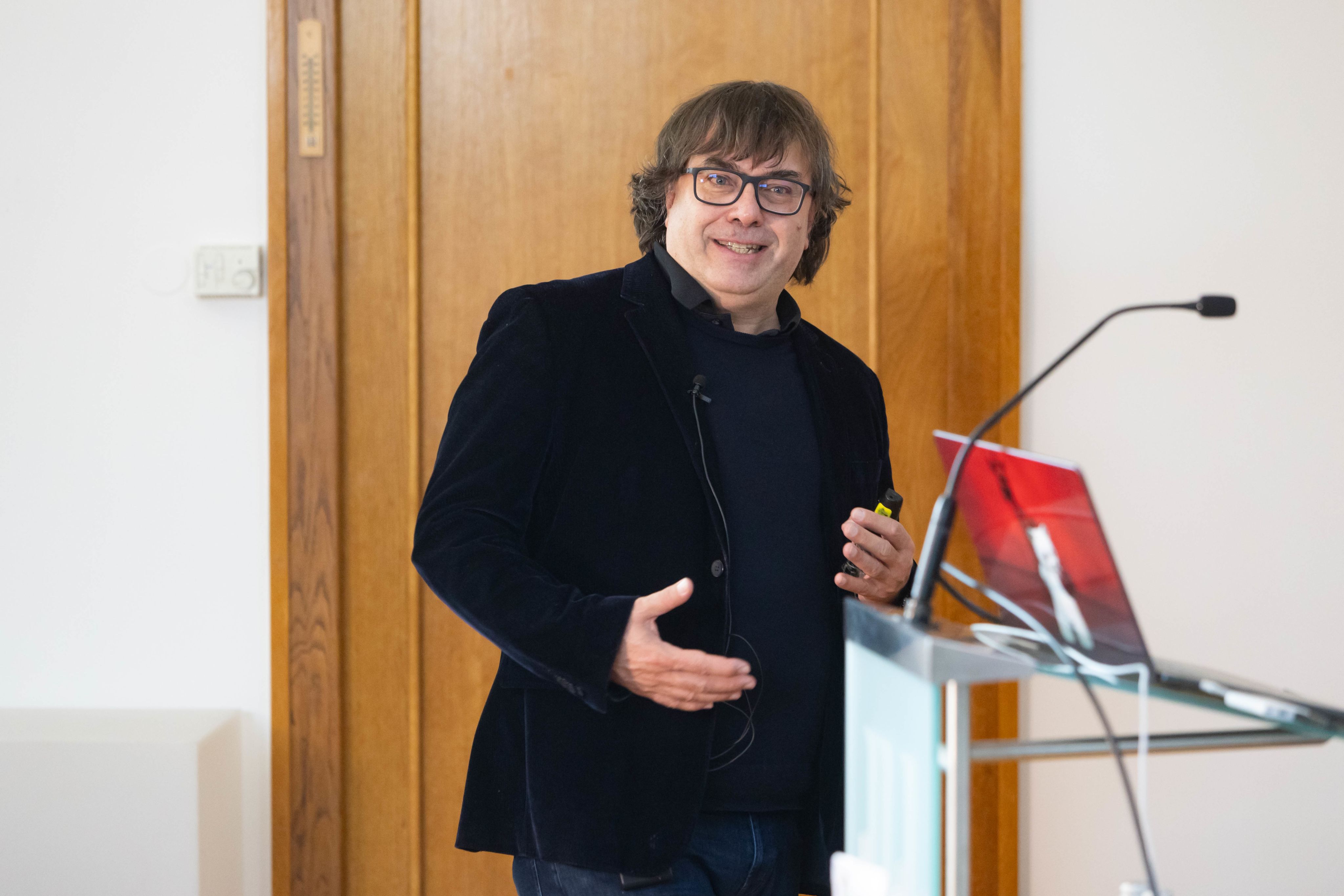

We're sitting down with the new Cavendish Professor to bridge computation, curiosity, and the human side of physics.
When Nicola Marzari officially assumed the Cavendish Professorship of Physics at the University of Cambridge in September 2025, he joined a distinguished lineage that stretches back to James Clerk Maxwell in 1871. Following figures such as J. J. Thomson, Lord Rayleigh and Nevill Mott might appear a daunting legacy, but Marzari meets the challenge with humility and quiet confidence.
He smiles at the mention of his predecessors. “It’s both humbling and inspiring,” he says. “The best way to honour the past is to help the next generation thrive. For me, it’s about creating the right environment for my students and colleagues to do well. That’s where the real impact lies.”
From Lausanne to Cambridge
Before returning to Cambridge, Marzari was for ten years on the faculty at MIT, and for another fourteen years at the École Polytechnique Fédérale de Lausanne (EPFL), where he led one of Europe’s leading groups in condensed-matter physics and computational materials science. The transition, he explains, will be gradual. “This semester I’m still mostly in Lausanne, but already planning future proposals and projects. From next spring I’ll start being in Cambridge more frequently, and by September I’ll be fully based here. Moving is not only about packing boxes – but also about moving people, ideas, and the rhythm of work.”
He speaks warmly of the new Ray Dolby Centre, now home to the Cavendish Laboratory. “It’s an incredible building,” he notes. “For theoretical and computational work, what matters most isn’t instrumentation but atmosphere, community, and connectivity. The new space brings energy, collaboration, and
a sense of renewal.”


CavMag editors Daniel Robins, Bofeng Xue and Minglei Zhang interviewed Nicola Marzari on Zoom
CavMag editors Daniel Robins, Bofeng Xue and Minglei Zhang interviewed Nicola Marzari on Zoom
Rethinking theories, expanding frontiers
Marzari’s research lies at the intersection of quantum mechanics, materials science, and computing. Over the years, his group has developed novel electronic-structure theories, algorithms, and open-source software to predict materials properties from first principles.
Looking ahead, he sees two major directions shaping the field. “We’re entering a new phase of theoretical understanding,” he explains. “We’re exploring correlated-electron systems using functional theories that go beyond the traditional nonperturbative or diagrammatic methods. The challenge is to capture complexity while keeping calculations tractable.” He also sees artificial intelligence as a transformative force. “AI is already able to analyse scientific papers in surprisingly deep ways. It sometimes makes mistakes but then again, so do experts. What’s fascinating, and slightly unsettling, is that we don’t yet fully understand how it arrives at its conclusions.”
“Discovery for its own sake is beautiful, but science should also help people and a distressed world.”
Science with responsibility
For Marzari, physics does not exist in isolation from society. “I believe physics must remain useful,” he says. “Discovery for its own sake is beautiful, but science should also help people and a distressed world.”
He cites energy as an example for some of humanity’s central challenges. “Access to electricity correlates strongly with education, health, and life expectancy. Ensuring global access to clean and affordable energy is essential. It’s not only a technical issue, it’s an ethical one.”
CavMag editors Daniel Robins, Bofeng Xue and Minglei Zhang interviewed Nicola Marzari on Zoom
CavMag editors Daniel Robins, Bofeng Xue and Minglei Zhang interviewed Nicola Marzari on Zoom
“Discovery for its own sake is beautiful, but science shoult also help people and a dsitressed world.”
A Journey from Trieste to Cambridge
Marzari’s own journey into physics began in Trieste, Italy. “I always loved mathematics,” he recalls, “though I didn’t enjoy physics in high school because I was missing the conceptual foundations. I was also drawn to philosophy. Coming from a non-academic family, I had little guidance. I initially wanted to
study to become an engineer, and even won a scholarship at the Sant’Anna School of Advanced Studies in Pisa to pursue this.”
A twist of fate and the advice of a close friend brought him to Cambridge in 1993 to pursue his PhD. “This was before the web, although we had emails” he laughs. “My future supervisor (Mike Payne) had to retype my entire EU application, lost in transit, and convince DHL to ship it on a Saturday. Without him, I would never have made it here.”
Image: TCM students and visitors in the Spring of 1994. Marzari is on the bottom left.
His years as a doctoral student left a lasting impression. “College was wonderful. I discovered choral music, which I still love. One unforgettable memory was hearing Keys’ graduate choir sing Allegri’s Miserere on Ash Wednesday. The sound in that space was transcendent.”
Beyond equations
Outside the lab, Marzari finds creative renewal through photography. “Years ago, I used to do street photography in distant countries,” he recalls. “People would rush to change into their cleanest shirts and pose for a group picture which it was a joyful event in itself.”
He now focuses more on wildlife, both above and below water, and finds energy in city life. “Switzerland was perhaps a bit too peaceful,” he admits with a laugh. “Cambridge, with London just around the corner, strikes a perfect balance.”
He remains passionate about both the art and the history of photography, and promises he would gladly help judge the Cavendish Laboratory’s annual photography competition.
Advice for the next generation
Asked what message he would offer to current Cambridge students, Marzari answers without hesitation. “Three words: driven, passionate, dedicated. Whatever you do, do it because you love it. I never thought I was particularly gifted in physics (math was my calling), but I was drawn to it. Success depends
on how much you care and persist.”
If he could write to his undergraduate self, he would offer reassurance. “Don’t worry about not being good enough. Everyone feels that way sometimes. Physics is vast and diverse so there’s room for everyone who truly wants to contribute.”
"Whatever you do, do it because you love it [...] Success depends on how much you care and persist."


With a colleague in the Cavendish’s TCM offices.
With a colleague in the Cavendish’s TCM offices.
With a colleague in the Cavendish’s TCM offices.
With a colleague in the Cavendish’s TCM offices.
With a colleague in the Cavendish’s TCM offices.
With a colleague in the Cavendish’s TCM offices.
With a colleague in the Cavendish’s TCM offices.
With a colleague in the Cavendish’s TCM offices.
"Whatever you do, do it because you love it [...] Success depends on how much you care and persist."
Coming full circle
When asked which of his predecessors he would most like to meet, he smiles. “Probably Nevill Mott, since his field is closest to mine, or J. J. Thomson, to ask how he managed to mentor seven Nobel laureates!”
Returning to Cambridge as Cavendish Professor feels, he says, “like coming home but with new responsibilities and new energy. Cambridge has always been a place where ideas and people meet, and I’m excited to be part of that dialogue again.”
From Trieste to Cambridge, from theory to inspiration, Nicola Marzari’s journey reminds us that physics is not only about equations and models, but about curiosity, creativity, and connection are the very qualities that continue to define the Cavendish spirit.


The pioneering work has earned Marzari wide recognition. Most recently, he received the 2026 David Adler Lectureship Award in Materials Physics from the American Physical Society. The award citation commends him “for new theory and method developments that have advanced the predictive power of first-principles calculations, and for sustained leadership and community-building in computational materials physics”.
Marzari will receive the award during the 2026 APS Global Physics Summit in Denver, Colorado, where he will give an invited talk on electronicstructure simulations.
On the award, Marzari commented that “it is always deeply honouring to be recognised by peers, and for an award that has such a distinguished record; equally satisfying is the recognition of the impact of electronicstructure calculations in science and technology, and their role in building scientific communities worldwide”.
Marzari also just received the Theory Feynman Prize in Nanotechnology from the Foresight Institute. The Feynman Prizes recognise exceptional contributions to nanotechnology. According to the award citation, he is recognised “for the development of novel theories of heat transport at the nanoscale, including the exact relaxon solution of the Boltzmann transport equation, its coarse graining into mesoscopic viscous heat equations, and the introduction of the Wigner transport equation.”
The Cavendish Professors


1871–1879: James Clerk Maxwell
1871–1879: James Clerk Maxwell


1879–1884: Lord Rayleigh
1879–1884: Lord Rayleigh


1884–1919: J. J. Thomson
1884–1919: J. J. Thomson


1919–1937: Lord Rutherford
1919–1937: Lord Rutherford


1938–1953: William Lawrence Bragg
1938–1953: William Lawrence Bragg


1954–1971: Nevill Mott
1954–1971: Nevill Mott


1971–1984: Brian Pippard
1971–1984: Brian Pippard


1984–1995: Sam Edwards
1984–1995: Sam Edwards


1995–2020: Richard Friend
1995–2020: Richard Friend


